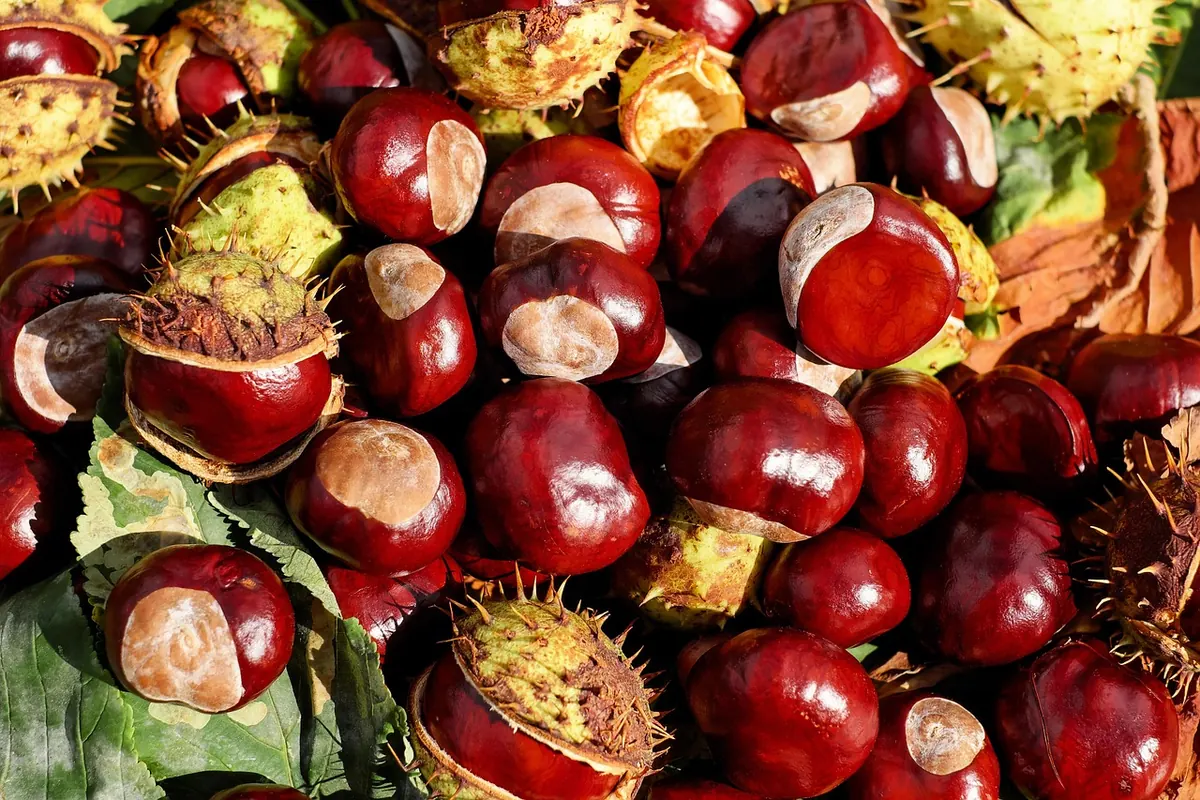


Most conker games assume two players, a length of string and a grudge. That works fine until eight people turn up with a carrier bag of horse chestnuts and nothing to do with them. Group conkers needs a different shape: teams, targets, a bit of running about, and rules simple enough to explain in under a minute.
The five games below all use the same basic kit — conkers, a few household items and some open space. They work for a birthday party in the garden, a class on the school field, or a family gathering where ages run from five to seventy.
1. The Bucket Brigade Relay
Set two buckets ten metres apart for each team: one full of conkers, one empty. Players line up behind the full bucket. The job is to move every conker, one at a time, to the empty bucket — without touching it with their hands.
Carrying methods are where the game lives. A spoon held in one hand is the standard. Balance a conker on the back of your hand and walk carefully. Sandwich one between two plastic cups. For older players, stack two conkers on a spoon and watch the wobble begin at about the fifth step.
Decide the dropped-conker rule before you start, because you will need it. Either send the player back to the start, or let them pick it up where it fell but deduct a point. Both work; the second keeps younger players moving, which matters more than fairness on a cold afternoon.
Score one point for finishing first and a point for every conker in the empty bucket at the whistle. That way a slow, careful team can still beat a fast, clumsy one.
2. Conker Skittles: Ten Pins, One Nut
Skittles needs nothing more than ten plastic bottles, a few cardboard tubes or a stack of paper cups on a smooth surface. A hallway, a kitchen floor or a table all work, which makes this the pick for a wet day indoors.
The conker is the ball. Roll it underarm from a taped line two or three metres away. Because conkers are lumpy and rarely roll straight, this is far harder than it looks — and far more entertaining to watch.
Give each player three rolls per turn. Teams add their scores together, and the bottle knocked over counts whether it fell by conker, bounce or wobble. For a longer game, set the skittles up in a triangle and award bonus points for clearing the middle.
Two useful tweaks: put a large conker at the front as a stubborn "king pin" worth five, and let the youngest players roll from a line a metre closer.
3. Conker Golf: Build a Six-Hole Course
A conker golf course is quicker to build than a real one. Mark six to nine holes around a garden or field using plant pots, chalk circles, shoeboxes on their sides or a gap between two flowerpots. Mark the route with canes, string or upturned cones so nobody wanders into the flowerbed.
Players flick their conker with a finger, or nudge it along with a short stick, counting every stroke until it lands in the hole. Set a par for each hole — two or three is about right for an open stretch, four for anything with a tricky turn.
For teams, play as a scramble. Everyone on the team takes a shot, the team picks the best one, and everybody plays from there. Total strokes decide the winner. This keeps a nine-year-old and a grandfather on the same side rather than against each other, and the better player simply has more chances to rescue the team.
4. The Conker Hunt and Sort
This one needs a hundred conkers or more and a patch of ground with some cover. Scatter them widely — under benches, along a wall, in long grass — then give each team three minutes to collect as many as they can.
The twist is the sorting stage. After the hunt, teams have five more minutes to pick out their best finds for bonus points:
- Ten perfect conkers — smooth, unmarked, no weevil holes
- The smallest and the largest in the whole pile
- The oddest — a twin conker, a flattened one, a shell split open
- The best colour match to a chosen conker held up by the organiser
Judging the oddest is cheerfully subjective, so let the group vote and keep it quick. This game suits mixed ages better than any of the others, because sharp eyes beat strong arms.
5. Conker Boules: Target Toss for Points
Draw or lay out three circles at increasing distances, or use hoops, and give them values of one, three and five. Players throw underarm from a line. Highest team total after an agreed number of rounds wins.
For the boules version, throw one small conker — the jack — onto open ground, then take turns tossing. The team whose conker finishes closest to the jack scores a point for each of their conkers nearer than the opposition's best. Play to eleven. It rewards a gentle, accurate throw rather than a hard one, and it gives everyone a second turn to fix a bad first attempt.
Keep throws flat and low, and never aim anywhere near where people are standing.
Set-Up, Scoring and Kit
Almost everything you need is already in the house. A short list covers all five games:
- A bag of conkers, sorted roughly by size
- Buckets, bowls or plant pots
- Spoons, plastic cups, string and chalk
- Plastic bottles or paper cups for skittles
- Canes, cones or string for marking lines and courses
- Paper and a pen for scores
Rules that keep everyone playing
Two or three teams of three to six players is the sweet spot. With more than about twenty people, run two activities side by side and rotate.
Adjust by age rather than ability: shorter distances, closer throwing lines and extra attempts for the youngest. Give each team a mix of ages where you can, and let teams choose a name — it takes thirty seconds and doubles the noise level in a good way.
Keep a running scoreboard somewhere visible. Close games are better than easy wins, so consider a handicap system: the leading team loses one throw per round, or gets an extra metre added to their throwing line.
Safety and Clearing Up
Conkers are hard and heavy for something that grows on a tree. No throwing at people, no swinging a conker on a string at head height, and no games in the dark. If you are drilling holes for string, an adult should handle the drill. Wear old clothes, since the juice marks fabric.
Horse chestnuts are not edible and can make dogs and other animals ill, so collect every conker at the end of the session — including the ones that rolled under the shed. Wash hands afterwards, especially before eating.
Pick Your Game and Go
If your group is mixed ages and you have twenty minutes, start with the conker hunt. If you are indoors on a wet afternoon, set up skittles in the hallway. For a competitive crowd of adults, conker boules or a scramble round of golf will keep them occupied for an hour.
And keep the traditional two-player battle in the bag. Finish the afternoon with a knockout tournament on strings — after the relays and the tossing, even a bruising loss feels like a fair way to end it.
Photo: Silvo / Pixabay